Camera Vocabulary for Kids
Photography and Camera Vocabulary for Kids: Words and Activities teaches 24 core terms for taking, describing, and discussing photos. Begin with nouns such as “camera” and “lens,” then add actions such as “zoom in” and “hold still.” Teach four to six terms through a short photo task, then revisit them. Activities need only a toy camera, digital camera, or adult-guided phone.
Core Camera Words and Phrases
Choose words your child can see or act out. Point to each camera part, say its name, and ask your child to repeat it in a sentence. Have the child perform each action phrase while taking a photo.
Photography and Camera Vocabulary for Kids: Words and Activities ties each word to a decision. Ask, “What is your subject?” or “Should we zoom in?” instead of testing definitions. Expand one-word answers: “Flower” becomes “The flower is my subject.”
Putting Camera Words into Sentences
Build sentences in three steps: name the object, add an action, and describe the result. “This is a camera” grows into “I point the camera at the cat,” then “The cat looks sharp, but the background is blurry.” The pattern moves young learners from labels to full speech.
Practise “Hold the camera carefully,” “Move closer,” “Zoom out a little,” and “Keep the subject in the frame.” Add polite phrases: “May I take your photo?”, “Please hold still,” and “Would you like to see the photograph?” Teach children to ask before photographing another person.
In LearnLink lessons, our tutors adapt speaking tasks to each child’s age and English. At home, Photography and Camera Vocabulary for Kids: Words and Activities reinforces that skill: one person gives an instruction; the other follows it and describes the result.
Photography Activities by Age
For school-age kids, try a picture hunt with four targets: something red, something round, a favourite toy, and a smiling face with permission. Say each target aloud before shooting. Then ask “What is it?”, “Is it bright or dark?”, and “Who is the photographer?”
For school-age kids, Photography and Camera Vocabulary for Kids: Words and Activities can form a five-photo story: a beginning, three events, and an ending. The child orders the images and narrates: “First, I took a close-up” and “Finally, I zoomed out to show the whole scene.”
For school-age kids, set a design brief: one portrait, one close-up, and one wide scene. Share nothing online without parental approval. The child explains each choice: “I used the window as a bright background,” or “I framed the bicycle between two trees.” Older learners compare two photos and defend which communicates the idea better.
A Five-shot Practice Routine
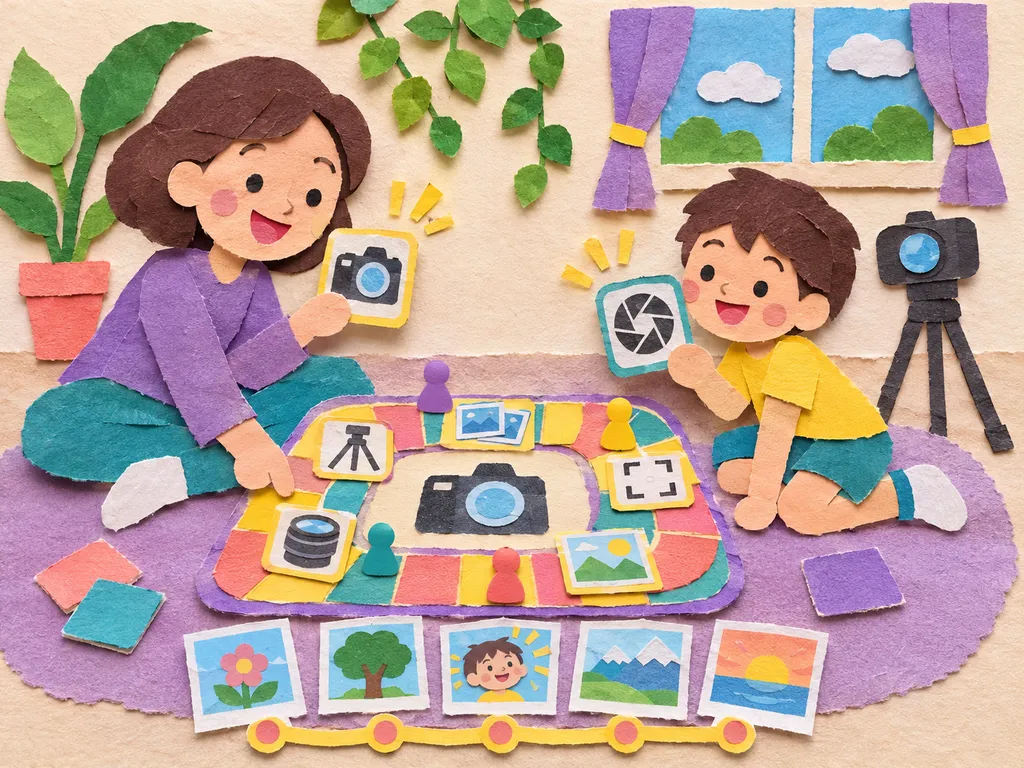
A short project gives each word purpose. Choose one safe place—a room, garden, or park—and limit the project to five shots. Repeat the routine another day instead of adding a long list.
Five-shot Camera Challenge
Take a close-up, a photo with a bright background, a photo with three objects in the frame, a sharp photo of something still, and a wide photo made by zooming out. After each shot, describe the subject and result in one sentence each.
Review the five images. Ask your child to choose one, explain how it was made, and suggest one change. “What would happen if you moved closer?” and “Which part should be in focus?” develop camera vocabulary and reasoning.
Camera Words Children Often Mix Up
Contrast overlapping terms instead of giving long explanations. Show two images or actions, name both terms, and ask your child to explain the difference. Accept a short answer, then model a complete sentence.
Do not interrupt every error. Let your child finish, repeat the sentence with the right word, and invite one more try: “Yes, the photo is blurry because the camera moved.” This protects meaning without making the activity a grammar test.
- Choose three confusing camera words and write each on a separate card.
- Point to each camera part and ask your child to name it.
- Sort six word cards into camera parts, actions, and finished pictures.
- Match four camera words to nearby parts or example photographs.
- Repeat one mixed-up word correctly in a clear new sentence.
When a word has several meanings or pronunciations, Cambridge Dictionary is a useful check before turning it into child-friendly examples.
Frequently Asked Questions
How Many Camera Words Should My Child Learn at Once?
Start with four to six words, then add more when your child uses them during a task. Photography and Camera Vocabulary for Kids: Words and Activities is a menu, not a test. A younger child might practise “camera,” “photo,” “smile,” and “hold still.” An older child may use “subject,” “frame,” “focus,” “close-up,” and “background.”
Does My Child Need a Real Camera to Practise?
No. Use a toy camera, paper viewfinder, or phone or camera under adult guidance. Connect words with actions: point, frame, pose, focus, and describe. Without taking a picture, your child can choose a subject and explain what belongs in the background.
How Can a Multilingual Family Practise These Words?
Connect English words to concepts your child knows. Briefly explain a term in another family language, then resume English. Reuse sentence frames such as “The subject is…” and “I zoomed in because…”. Knowing a camera term in another language is a bridge, not a mistake.
What Should I Do When My Child Uses the Wrong Camera Word?
Answer the meaning first, then model the correct term. If your child says “The camera is blurry,” answer, “Yes, the photo is blurry. The camera moved.” Request one natural repetition and continue. For two confusing words, compare real examples instead of memorising dictionary definitions.
Start your child's English journey today — book a trial lesson with LearnLink.
Stay updated on our latest tips and resources by following us on Instagram LearnLink.